
Author: Andrew Hall, Co-owner and Lead Performer at Realm of the Reptile
It’s a focused window—one intentional week—where your school can clearly show students, parents, parish, and community what Catholic education forms, why it matters, and how it shapes lives long after graduation.
When Catholic Schools Week is planned with intention, the impact is unmistakable.
Faith feels lived. Community feels real. Purpose feels shared.
Faith.
Family.
Excellence.
Community.
These four pillars are the foundation.
When your week is built around them, everything comes alive: the liturgies, the assemblies, the themed days, the conversations in the hallway, even the energy students carry home at night.
Whether you’re a principal, teacher, campus minister, or PTO/PTA leader, these seven ideas will help you design a Catholic Schools Week that is:
Spiritually grounded
Joyfully energetic
Clear in purpose
Worth remembering long after Friday
And at the end, there’s one bonus move that helps the week continue shaping culture well beyond January.
…And have you ever wondered?
(If you miss this, everything else becomes just activity.)
Catholic Schools Week didn’t appear by accident.
It was first celebrated nationally in 1974, created through a joint effort of Catholic education leaders and the bishops of the United States. The goal was simple—but bold: to tell the story of Catholic education at a time of enormous cultural and ecclesial change.
In the years following Vatican II, Catholic schools were transitioning from religious-staffed models to lay leadership, facing enrollment challenges, and re-articulating their purpose in a modern world. The bishops addressed this directly in their landmark document To Teach as Jesus Did, calling Catholic education to be communities of:
“Faith, worship, and service.”
Catholic Schools Week was born to make that visible.
As Catholic education leaders said at the time, there needed to be “a national celebration of the good work and ministry of Catholic schools”—a unified moment when schools could publicly recommit to their mission and invite the wider community to see it for themselves.
That historical purpose matters. Because it tells us this:
Catholic Schools Week is not about filling a calendar.
It’s about forming people—and proclaiming why that formation matters.
Which brings us to the first two non-negotiables.
Catholic Schools Week works best when the purpose is stated clearly from the very beginning.
The opening moment should orient the entire community—students, staff, families—around a shared understanding of why Catholic education exists and what this week is meant to celebrate.
Effective openings include:
An all-school Mass to begin the week
A prayer service led by students with clergy and faculty
A blessing over students, teachers, families, and parish staff
A short vision-sharing assembly from the principal or pastor
In that first gathering, take time to answer three questions together:
Why does this school exist?
What does Catholic Schools Week celebrate?
How does each day of the week connect back to Jesus and the mission of the Church?
Stories matter here.
Share the graduate whose life direction was shaped by faith-filled teachers.
Highlight the faculty member whose quiet fidelity has formed generations.
Recall moments when the community came together in prayer and support.
Pro Tip:
Send a brief email to parents before the week begins outlining the theme and purpose. Clarity ahead of time builds anticipation and participation. Parents are waiting to be lead and inspired to action!
When the mission is announced, the week naturally aligns around it.
Every Catholic school carries a unique expression of the Church’s mission.
Catholic Schools Week is the time to make that identity visible, tangible, and personal.
Practical ways to do that include:
Visual Witness
Hallway saint banners with student-written biographies
Classroom doors themed around “Where We See God in Our School”
Displays connecting academic work to faith and service
Storytelling
Short teacher faith reflections shared during the week
Alumni stories showing how Catholic education shaped vocation, family, or service
Student reflections on how faith shows up in their daily learning
Student Involvement
“Faith in Action” posters highlighting service projects
Morning announcements with Scripture or saint connections
Catholic identity should shape:
The language used throughout the week
The tone of assemblies and announcements
The way guests are welcomed
The stories that are highlighted
When identity is clear, celebration has depth. In a world of 2026, when everyone is changing identities, their Catholic identity should be the sun of their universe throughout all of their education.
When identity is visible, education has meaning and purpose.

Early momentum matters.
A strong opening experience captures attention, sets expectations, and signals that the week will be both meaningful and memorable.
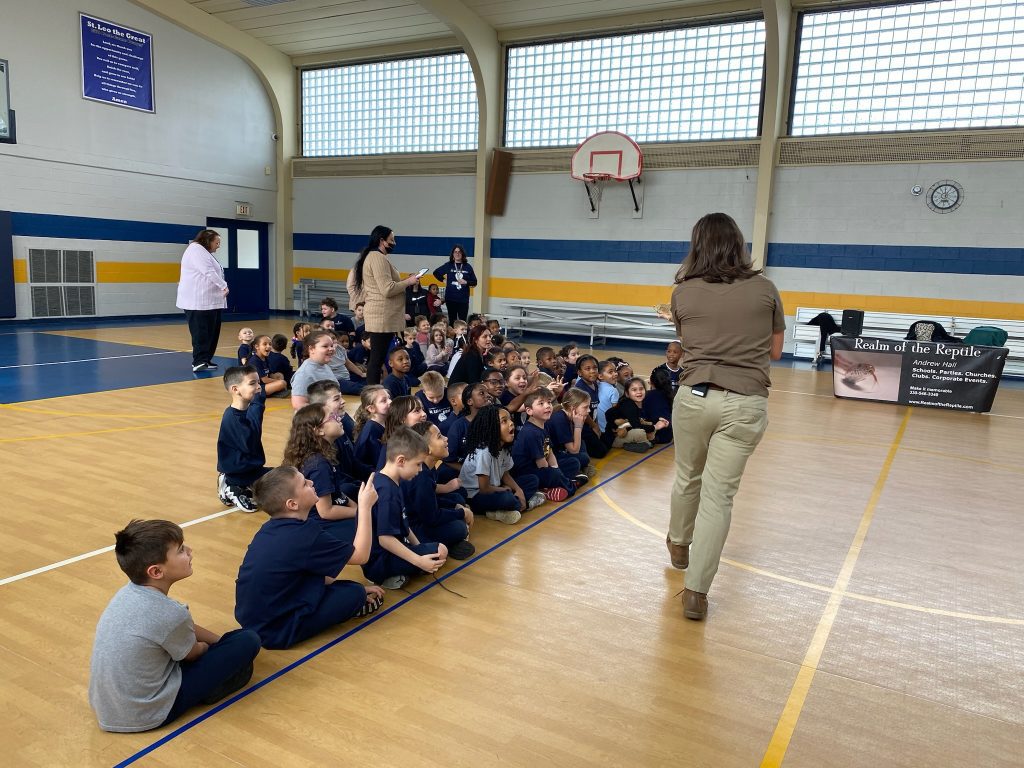
This is where Realm of the Reptile has become a trusted and effective staple for Catholic Schools Week.
Realm of the Reptile is a live animal educational experience that highlights God’s creation through science, storytelling, and hands-on engagement. Students encounter reptiles and other creatures while learning about design, stewardship, and wonder.
When we walk into a Catholic school, we bring:
High-energy science explanations
Interactive learning moments
Clear connections between creation and the Creator
Students don’t just hear about Genesis—they experience the order, complexity, and beauty of creation in real time. That experience stays with them.
Other strong kickoff options can include:
A mobile planetarium focused on the order of the universe
A guided nature walk tied to stewardship (coats required, haha)
A Catholic performing ministry or missionary speaker. Any vendor who isn’t familiar to the students.
Planning tips for administrators:
Schedule the WOW experience early in the week
Use grade-level rotations if needed
Communicate expectations clearly with staff and families
A strong opening builds momentum that carries through the rest of the week.
Catholic Schools Week succeeds when adults feel supported and valued.
Teachers, staff, and parents shape the tone of the week more than any schedule ever could. Why would anyone intentionally put their child into a catholic school? BECAUSE THEY CARE!
Ways to build adult engagement include:
Staff appreciation breakfasts or lunches
Handwritten gratitude notes from students (a parent or adult whom the child isn’t related to gets an appreciation card)
Simple, clearly defined volunteer roles for parents
A surprise banquet for parents planned and put on by the students
Partnership idea:
Pair parents and teachers for co-led activities—reading time, service projects, or classroom support. Shared ownership builds trust and community.
When adults feel encouraged, students feel it immediately. “…parents must be acknowledged as the first and foremost educators of their children” – Pope St. John Paul II
Themed days are effective when they reinforce the values of the school.
Examples that work well:
School Colors Day: Belonging and shared mission
Silly Socks Day: God’s intentional creativity and uniqueness of each human being
Saints Day: Witness, virtue, and the communion of saints
Catholics Got Talent: God-given gifts offered for the good of others
Invite student input by polling classes ahead of time. Buy-in increases when students feel heard, seen and valued.
Joy and talent sharing is a powerful teacher when it is connected to meaning and community.
Students grow when they are trusted with responsibility.
Create a Catholic Schools Week Student Leadership Team and give them real roles:
Leading morning prayer
Hosting assemblies
Organizing service projects
Running the talent show or trivia events
Adults mentor and guide, but students should be allowed to make decisions and solve problems. Try pairing an older student with 1 or 2 younger students. It adds a family bonding environment when you do things to cross the class border and get grades interacting and looking after each other.
Commissioning student leaders publicly—perhaps even at Sunday Mass—communicates trust and responsibility. Nothing inspires good action like a public affirmation.
Ownership leads to formation that lasts, and creates citizens that we value and look up to.
(Because Catholic education forms households, not just students.)
Catholic schools exist in partnership with families. That partnership doesn’t pause during Catholic Schools Week—it should be on full display.
The goal here isn’t to ask families to do more.
It’s to invite them into what’s already happening in a way that feels natural, welcoming, and meaningful.
The strongest approach is offering multiple, low-pressure entry points, knowing that every family’s availability looks different.
Effective options include:
Family Classroom Visits or Lunches
Invite parents to join their child for part of the school day—Mass, a special presentation, or lunch. Even short windows of access help families see faith and learning integrated in real time.
Grandparent & Alumni Mornings
Set aside a morning where grandparents and alumni can visit classrooms, listen to students read, or share a short story about “school back then.” This reinforces continuity and gratitude while helping students see themselves as part of a longer story.
Simple Family Night Gatherings
Keep it uncomplicated: light refreshments, student performances, classroom art displays, or a short communal prayer like a living rosary. The goal is connection, not production value.
To deepen impact, capture and share legacy stories during the week:
Short alumni reflections in newsletters
A “Why We Chose Catholic Education” parent quote “bulletin board”
Social media spotlights highlighting multi-generational families
These stories quietly reinforce a powerful truth: Catholic education is an investment that carries forward across decades and generations.
When families feel welcomed as partners—not spectators—school culture strengthens in ways that last far beyond the week itself (which, isn’t that the point of this week?).
The worst thing you can do? Have an amazing week—and then… nothing.
By Monday, it’s like it never happened.
Wise schools don’t just run events, they build memories and momentum. That means you need a plan to capture, reflect on and re-live the week.
Here’s how to do that:
Create a Photo/Video Team
Daily Recaps
Collect Reflections
Build a “Next Year” Folder
When you pause to reflect, you send a clear message:
Catholic Schools Week is sacred.
Catholic Schools Week is an opportunity to live the mission clearly and publicly.
When you:
Lead with purpose
Make identity visible
Create meaningful experiences (like Realm of the Reptile)
Support adults/parents
Empower students
Welcome families and generations
Reflect intentionally
You reinforce why Catholic education transforms lives.
The result is a week that shapes memory, strengthens culture, and points students toward lives of faith, service, and leadership.
Here’s to a week filled with purpose, laughter, reverence, service, and joy and to a school that keeps living that mission long after the banners come down.